Multi-Format Parsing
Scans `.pst`, `.msg`, `.pdf`, `.docx`, `.xlsx`, and nested `.zip` files.
High-Throughput Forensics Ingestion Engine
Turn PSTs, emails, documents, PDFs, archives, and attachments into structured, searchable evidence on your local machine without sending it to the cloud.
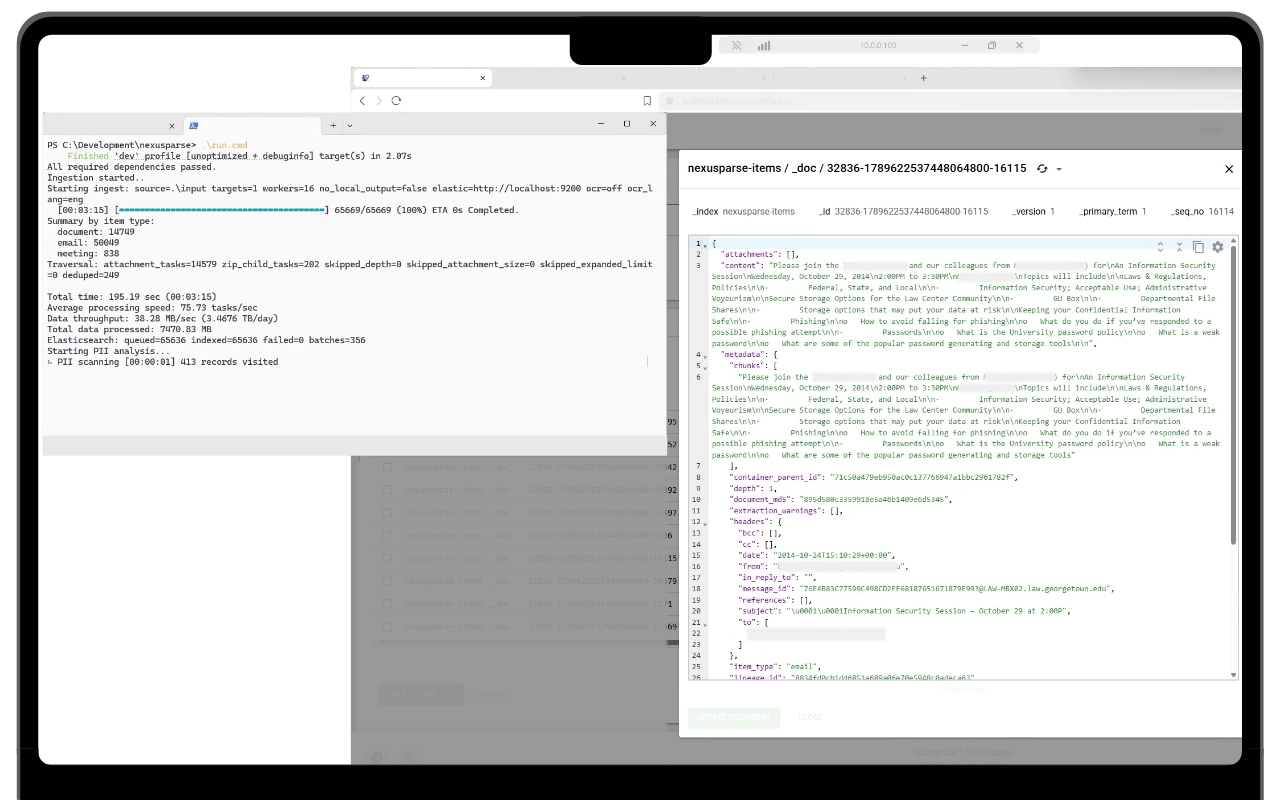
Scans `.pst`, `.msg`, `.pdf`, `.docx`, `.xlsx`, and nested `.zip` files.
Parseable attachments are processed recursively, including archives and email files.
Detect personal information across unstructured data. NexusParse combines regex detection with AI-powered semantic analysis to identify sensitive information beyond simple text matching.
Parent and thread IDs preserve message relationships across PST extractions.
Tesseract-backed OCR is used when installed and PDFs contain little to no text.
Email-aware and document-aware chunking supports retrieval and AI workflows.
Stream indexed items in bulk while ingesting, or run with local output only.
Run ingestion and iterate output items for local automation.
Output folders mirror source structure so lineage and provenance stay auditable.
Integrate NexusParse into your existing workflows with CLI and Python SDK support.
Use include/exclude filtering with recursive scanning for archives and attachments.
nexusparse --source ./input --output ./output --format json --verboseEach item is written as unified JSON, and you can optionally export centralized RAG JSONL chunks.
Extracted items follow a consistent structure:
{
  "content": "Hi Adam, please find the attached contract...",
  "metadata": {
    "subject": "Contract Review",
    "from": "alice@example.com",
    "to": ["adam@example.com"],
    "date": "2026-08-14T10:32:00Z"
  },
  "source": {
    "file": "case/mailbox.pst",
    "path": "Inbox/Project Beta"
  },
  "attachments": [
    "contract.pdf"
  ],
  "parent_id": "...",
  "thread_id": "..."
}No. NexusParse is designed for local-first processing. Files are processed within your environment and output is written to a destination you specify. No external data transfer is required.
Yes. NexusParse is designed for automated ingestion workflows. Run jobs through the CLI or Python SDK and integrate them with CI/CD pipelines, scheduled jobs, internal data pipelines, and existing orchestration systems.
OCR is optional and used only when Tesseract is installed on your host.
No. PostgreSQL is not required. NexusParse can write processed output to a destination you specify, with optional integration for streaming data to Elasticsearch.
Yes. NexusParse is designed for environments where data control and locality are important. Processing can be performed within your own infrastructure, helping keep sensitive documents and extracted data under your control.
Yes. NexusParse provides CLI and Python SDK interfaces so ingestion can be incorporated into existing applications, pipelines, automation, and data processing workflows.
NexusParse is designed to run within your own environment, allowing you to deploy it alongside your existing infrastructure and data workflows.
NexusParse is designed for high-volume unstructured data ingestion, including document repositories, email archives, legal collections, eDiscovery datasets, and data preparation workflows for AI and RAG systems.
Designed for core file discovery.
Designed for teams requiring searchable content, OCR, and sensitive-data discovery.
Designed for advanced ingestion and data discovery workflows.
Tell us about your data volume and ingestion needs, and our team will help you find the right NexusParse setup and pricing.